
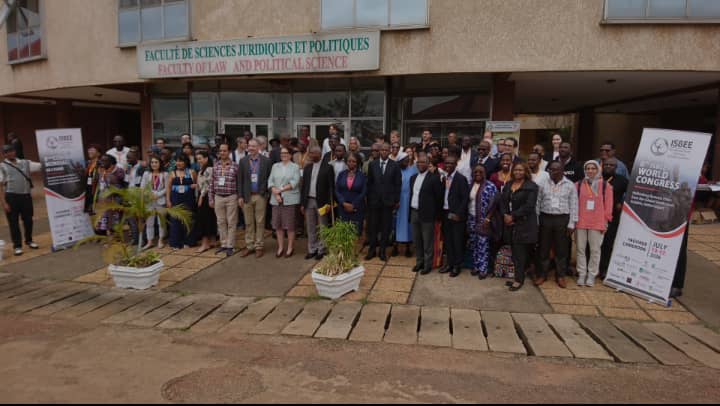
The 8th World Congress of the International Society of Business, Economics and Ethics (ISBEE) has brought together leading academics, policymakers, entrepreneurs and practitioners in Yaoundé, Cameroon, for a major reflection on the future of ethical business. Hosted at the Catholic University of Central Africa (UCAC) from 14 to 16 July 2026, the international gathering focuses on the theme: “Rethinking Business Ethics from the Global South: Local Insights, Global Impact.”
A global forum challenges the traditional foundations of business ethics.
For its eighth edition, the ISBEE World Congress has chosen Cameroon as the stage for a profound intellectual encounter on the evolution of business ethics. Often described as the “Olympics of Business Ethics”, the event is opening a new chapter in global conversations by questioning established approaches and inviting a wider diversity of experiences into the debate.
For several decades, theories surrounding corporate responsibility, governance and ethical decision-making have largely been influenced by Western academic traditions. In Yaoundé, researchers are examining how these frameworks can be enriched by alternative perspectives emerging from Africa, Latin America, Asia and other regions whose contributions have long remained on the margins of international discussions.
The central ambition of the congress is not simply to apply existing ethical models to different environments, but to reconsider the very foundations upon which these models have been built. Participants are exploring how cultural heritage, community values and historical experiences can contribute to the creation of more inclusive approaches to economic responsibility.
The presence of scholars from different continents reflects the growing recognition that contemporary challenges require a plurality of voices. Issues such as inequality, climate change, social vulnerability and technological transformation are pushing businesses and institutions to rethink their responsibilities towards societies.
Cameroon becomes a meeting point for new ethical narratives
The choice of Yaoundé as host city carries a symbolic dimension. By bringing this major international event to Central Africa, ISBEE is highlighting the importance of knowledge produced outside traditional centres of academic influence. The congress positions the continent not only as a place where global theories are implemented, but as a source of ideas capable of transforming international practices.
African philosophical traditions, including concepts such as Ubuntu and relational approaches to justice, are among the perspectives inspiring discussions. These traditions emphasise interconnectedness, collective well-being and the responsibility of individuals and organisations towards their communities.
The debates also address the complex realities faced by African economies, including the consequences of colonial history, resource exploitation, economic dependency and institutional challenges. Yet participants underline that these difficulties coexist with remarkable creativity, resilience and locally driven innovations.
Through these exchanges, the congress seeks to establish a more balanced relationship between different knowledge systems. It encourages researchers and professionals from the Global South to participate actively in defining future directions for business ethics rather than remaining contributors to agendas developed elsewhere.
High-level voices call for a transformation of corporate responsibility
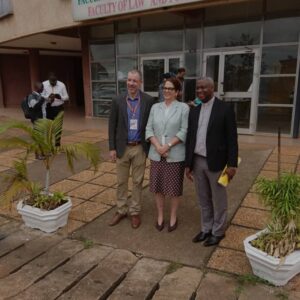 During the opening sessions, several international figures have offered perspectives on the need for a renewed understanding of ethical leadership. H.E. Natalie Kohli, Ambassador of Switzerland, emphasised the importance of considering local realities, cultural values and community resilience when shaping responsible business practices. She also highlighted the cooperation between the University of St. Gallen in Switzerland and the Catholic University of Central Africa.
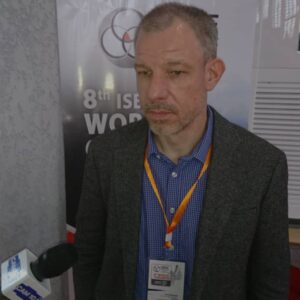
Prof. Florian Wettstein, President of ISBEE and Chair of Business Ethics at the University of St. Gallen, delivered a presidential address entitled “Decolonizing Decolonization – or: Why is ISBEE going to Cameroon?” His intervention examined the reasons behind the organisation’s decision to hold the congress in Africa and reflected on the transformation of ethical knowledge.
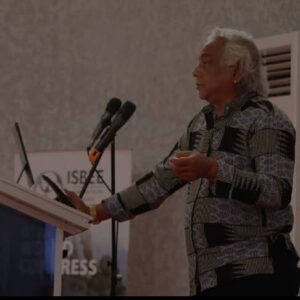
Prof. Bobby Banerjee from Bayes Business School, City St George’s, University of London, presented the inaugural keynote address focusing on “The Coloniality of Corporate Social Responsibility and Accountability: Perspectives from a Genocide.” His contribution explored the links between corporate responsibility, historical power structures and postcolonial perspectives.
These interventions set the tone for a programme designed around critical reflection, academic dialogue and practical solutions for organisations facing increasingly complex ethical dilemmas.
From leadership to sustainability: a wide-ranging intellectual agenda
Throughout the congress, participants are examining numerous themes that connect ethics with contemporary economic realities. Discussions focus on ethical leadership in periods of uncertainty, responsible governance, sustainability strategies and the role of education in preparing future business leaders.
Several sessions explore how companies can integrate values-driven leadership while respecting cultural identities and community expectations. Others investigate the relationship between business performance, social responsibility and reciprocity, particularly from the perspective of entrepreneurs operating in emerging economies.
The role of indigenous knowledge, data governance, digital responsibility and social media morality also features prominently among the topics addressed. Researchers are questioning how technological developments can be guided by ethical principles adapted to diverse social contexts.
Energy transition, climate justice and the search for sustainable development models are equally central to the discussions. Perspectives inspired by African Ubuntu, Asian concepts of collective happiness and Latin American ideas such as Buen Vivir illustrate the diversity of approaches presented during the event.
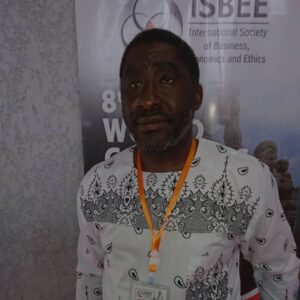
EthicsLab and UCAC at the heart of a historic academic partnership
The organisation of the congress in Cameroon is supported by EthicsLab, the Ethics and Public Policy Laboratory founded by Professor Thierry Ngosso at the Catholic University of Central Africa. A political philosopher specialising in global justice, human rights, climate change and migration, Professor Ngosso has developed research exploring the moral responsibilities shared by states and corporations.
Through EthicsLab, he has contributed to strengthening academic cooperation between African institutions and international research networks. His work reflects a commitment to connecting philosophical reflection with the practical challenges affecting societies and organisations.
The collaboration between UCAC, EthicsLab and the Institute for Business Ethics of the University of St. Gallen illustrates the growing importance of partnerships between the Global North and the Global South. It represents an effort to build shared knowledge platforms capable of addressing global challenges through diverse intellectual contributions.
Towards a more inclusive future for business ethics
Since its creation in 1996, the ISBEE World Congress has travelled across continents, from Tokyo to São Paulo, Melbourne, Cape Town, Warsaw, Shanghai and Bilbao. Each edition has provided an opportunity to examine the ethical questions shaping economic life in different regions of the world.
The Yaoundé meeting marks a significant stage in this journey by placing African perspectives at the centre of global reflection. Beyond academic discussions, the congress raises a fundamental question: what kind of economic systems can emerge when responsibility, justice and human dignity become the foundations of corporate action?
By opening space for new voices and challenging inherited assumptions, ISBEE 2026 seeks to redefine the meaning of responsible business in a changing world. In Cameroon, the debate on ethics is no longer only about adapting existing models; it is about imagining new ones.